News
We report on achievements and press coverage of our work here. You can follow us on Twitter to receive even more updates.
We won the Best Paper Award at ACM WiNTECH’26
We are happy to announce that our work "BCMSDR: Breaking the Cost Barrier of High-Rate SDRs Using Commercial Wi-Fi Hardware" (Jakob Link, Stefano Fontana, Denis Festa, Matthias Hollick, Francesco Gringoli) was selected for the Best Paper Award at the 20th ACM Workshop on Wireless Network Testbeds, Experimental evaluation & Characterization (ACM WiNTECH'26) held in conjunction with the ACM MobiCom 2026 in Austin, Texas, USA. This year's workshop was a special one, as we celebrated its 20th anniversary. We are all the more pleased that our work is so highly valued. In our work, we show how to repurpose selected Wi-Fi devices into low-cost software-defined radio (SDR) platforms with direct access to raw IQ samples. We design and implement a host-to-baseband streaming architecture that enables raw IQ sample transmission and reception using commercial Wi-Fi hardware. The proposed platform, BCMSDR, supports continuous sending or receiving at 20 MS/s. Additionally, it supports burst-based operation with timed, non-continuous modes at 40 MS/s, 80 MS/s and 160 MS/s. Our platform works in the 2.4 GHz, 5 GHz and 6 GHz Wi-Fi bands on selected BCM43 chipsets.

We won the Best Full Paper Award at ACM WiSec’26
We are proud to announce that our publication "Pair-Fi: Integrity Code Protected Secure Device Pairing via SDR-Enabled Wi-Fi Chips on Smartphones" (Jakob Link, Florentin Putz, Matthias Hollick) was honored the Best Full Paper Award at the 19th ACM Conference on Security and Privacy in Wireless and Mobile Networks (ACM WiSec'26). Pair-Fi extends PairSonic, another of our award-winning works. Both works are open-source smartphone apps that enable two or more users meeting in person to spontaneously exchange or verify their contact information. Pair-Fi moves from PairSonic’s unstable and slow audio channel to an integrity guaranteeing, fast, and robust RF channel for user-friendly secure device pairing. Our PoC implementation runs on modern Google Pixel smartphones through exposing SDR-like transmit and receive capabilities of built-in Wi-Fi hardware - which at the same time opens up modern real devices to be equipped with recent wireless research ideas.

Three SEEMOO students win the 2024 CAST Award
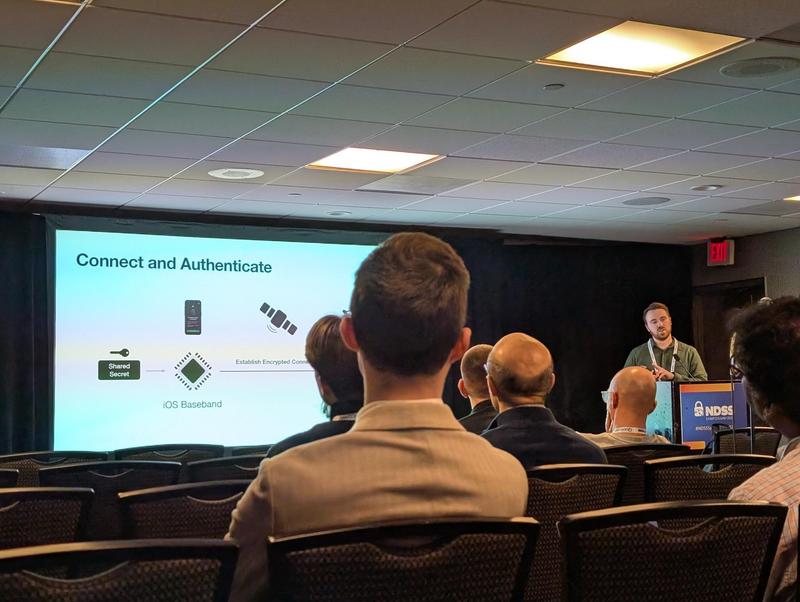
The annual CAST award recognizes outstanding bachelor and master theses in applied cybersecurity from all over Germany. This year, however, it almost feels like a class reunion: Three of the seven awardees are from here at SEEMOO. Noreen Mehler, Inga Dischinger, and me, Nils Rollshausen, all present our recently completed theses to the jury as the first snow falls on the Fraunhofer SIT.

We won the Best Paper Award at ACM CSCW 2024
We are proud to announce that our paper "Sounds Good? Fast and Secure Contact Exchange in Groups" (Florentin Putz, Steffen Haesler, Matthias Hollick) has received a Best Paper Award (top 1%) at ACM CSCW 2024. Check out this demo video about our app PairSonic, and further information (PDF, code, dataset) about this project.

AirGuard for iOS - Protection against Unwanted Tracking
AirGuard enhances the security of iPhone users by detecting personal tracking devices such as Samsung SmartTags and Tile trackers. People affected of unwanted tracking get a notification in less than an hour and are can then use the app to search for the hidden tracker.


Three SEEMOO and WISE thesis students won the Datenlotsen-Preis 2021 and 2022
We are happy to announce that Andreas Bäuml, Lukas Magel and Ben-Jasper Kettlitz won the Datenlotsen-Preis from 2021 and 2022. Every year, up to four graduates from computer science, mathematics or industrial engineering are honored for their outstanding Bachelor's and Master's thesis. The prices were handed over during this year's ceremony which took place at the Georg-Christoph-Lichtenberg-Haus on the 2nd of December.

AirGuard protects Android users from modern stalking methods
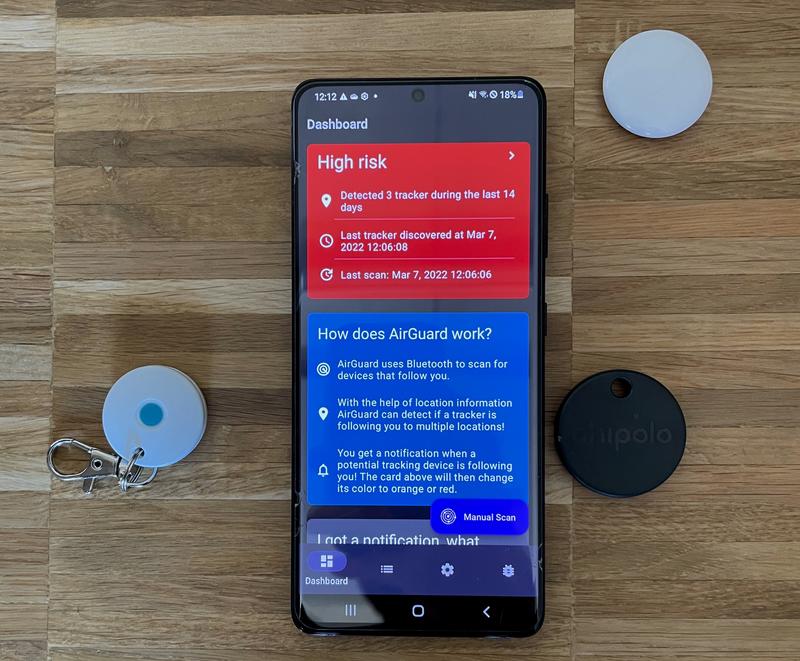
Our Android app AirGuard effectively helps to protect Android users from stalking attacks using Apple AirTags. The app has reached over 130,000 active installations, and several online media sites covered our app (CNET, heise, Spiegel).
BrakTooth affects iPhones and MacBooks
The newly released BrakTooth vulnerabilities also affect various Bluetooth chipsets that we analyzed in the past. We use our research frameworks - InternalBlue and Frankenstein - to make an in-depth assessment of these new vulnerabilities. Even though not listed by the BrakTooth researchers as of now, because Apple did not make the disclosure deadline, these vulnerabilities also affect iPhones and MacBooks. For more details, see our blog post.

Florentin Putz wins KuVS Best Thesis Award
Florentin Putz just won the Best Master's Thesis Award 2020 from KuVS for his research on ad-hoc acoustic communication. KuVS is the special interest group on Communication and Distributed Systems, which is jointly supported by the German Informatics Society (Deutsche Gesellschaft für Informatik, GI) and the Information Technology Society of VDE (Informationstechnische Gesellschaft, ITG).


Who can “Find My” devices?
It is supposed to make it easier to find Apple devices - but normally not for everyone. The offline finding system Find My from tech giant Apple is a tracking app that can find all of a user’s Apple devices, from MacBook to AirPod. Since the tracking relies on Bluetooth, it also works when the devices are offline or switched to flight mode. This is a practical function for all Apple users to see, for example, if one only forgot the iPhone in the office or if it actually fell from the pocket in the subway on the way home.